
Retail Store Buildout Cost: What Tenants and Landlords Should Budget
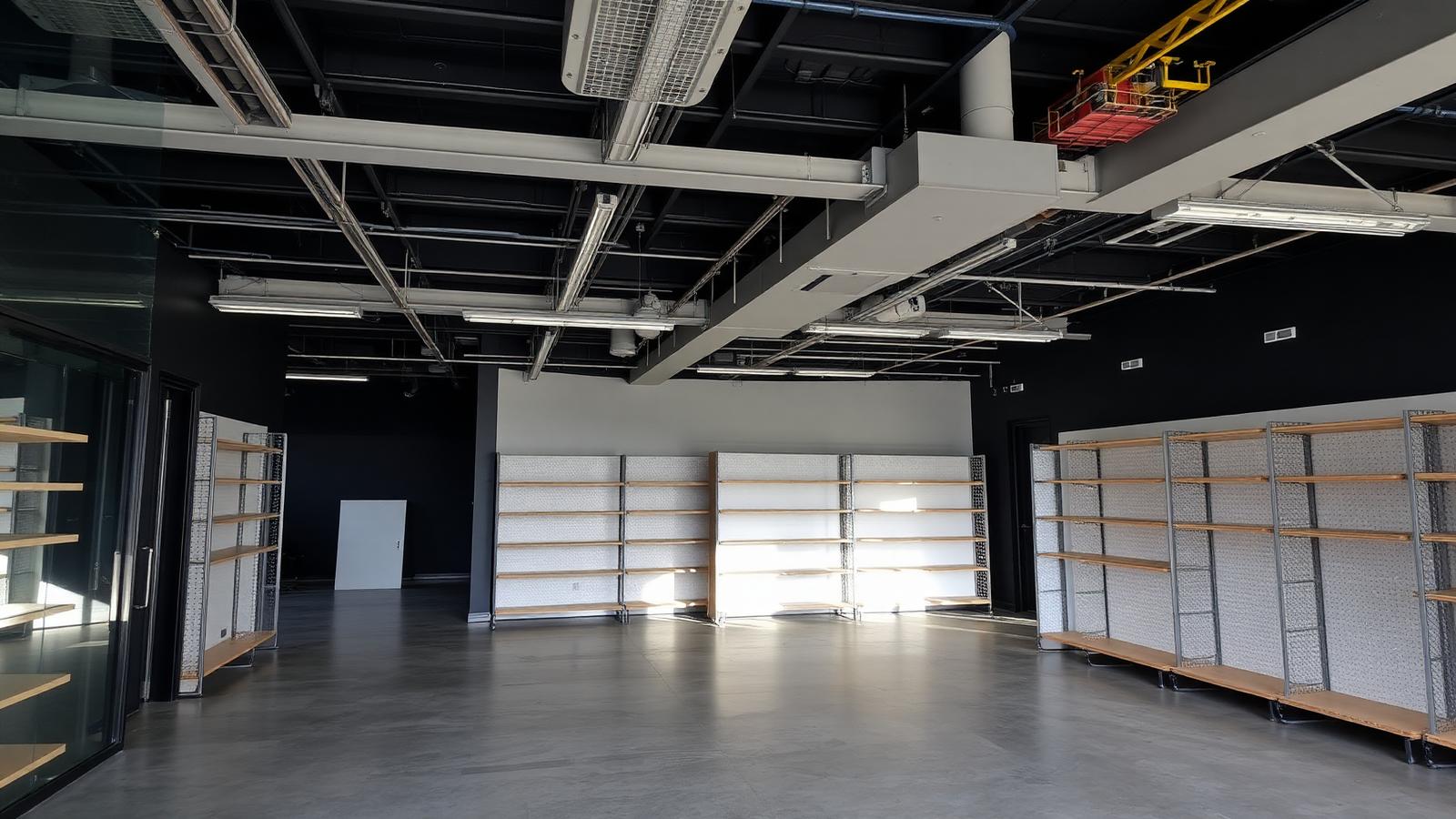
Retail store buildouts (also called retail finish-out or retail TI) sit at the intersection of landlord and tenant economics. The number on the work letter is rarely the number it actually costs to open the doors. This guide breaks down 2026 retail buildout costs by store type, what TI allowances really cover, and how to negotiate a lease that protects the project.
2026 Retail Buildout Cost Benchmarks
| Store type | Typical PSF (2026) | Notes |
|---|---|---|
| Soft-goods / apparel (vanilla → branded) | $150 – $275 | Fixtures often owner-supplied |
| Specialty retail (cosmetics, wireless) | $200 – $325 | Tech / fixture-dense |
| Furniture / mattress / large-format | $125 – $225 | Lower finish density, larger footprint |
| Banking / financial services | $275 – $425 | Vaults, security, ADA path-of-travel |
| Convenience store / fuel-adjacent | $250 – $450 | Coolers, food service |
| Flagship / brand-prototype | $350 – $650+ | Custom finishes, lighting, AV |
These ranges represent construction cost only — they exclude brand fixtures and FF&E (often owner-supplied), signage, IT/POS, and design fees.
Shell Condition Drives Everything
The single biggest variable is what you're starting with:
- Cold dark shell — no MEP distributed. Highest cost. Tenant pays for everything.
- Warm vanilla shell — MEP stubbed, basic ceiling, lights, restroom. Standard.
- Second-generation space — previous tenant's improvements remain. Lowest cost if the prior use matches; can be highest if MEP must be ripped out.
Two adjacent suites in the same building can have a 2× cost delta based on shell condition alone.
What the TI Allowance Actually Covers
Tenant Improvement Allowance (TIA) in the work letter is a number — not a scope. What it actually pays for depends on lease language:
- "Hard cost" only — construction only, no design, no FF&E.
- "Hard + soft" — construction plus design fees and permits.
- "All in" — includes some FF&E and signage (rare in 2026).
The lease almost always defines a landlord work scope (delivered before tenant takes possession) and tenant work scope (paid through TIA and tenant capital). Misunderstanding which side owns what is the most common source of buildout overruns.
Negotiation Levers Before Lease Execution
- TIA per usable SF, not rentable SF — meaningful difference on multi-tenant retail.
- Cash vs. amortized — cash today vs. baked into rent at landlord's cost of capital.
- Definition of "delivered shell" — write the deliverable, do not assume.
- Permit and design fee responsibility
- Drop-dead delivery date with landlord penalties if shell is late
- Rent commencement tied to substantial completion, not lease execution
- AHJ feasibility contingency — back out if the AHJ blocks the use
Where Retail Projects Lose Money
- Signing the lease before AHJ verification of intended use
- Underestimating ADA path-of-travel triggers in older buildings
- Vendor fixtures with long lead times not coordinated with construction
- "Special inspections" not in the original GC scope
- Punch list dragging because closeout was not planned
Where Retail Projects Save Money
- Standardize prototype design and value-engineer with the GC at DD
- Order long-lead equipment and fixtures at DD, not CDs
- Use the same GC across markets for multi-site programs (knowledge curve)
- Negotiate TIA against documented PSF benchmarks, not landlord proposals
Multi-Site Retail Programs
If you are opening more than three stores in a year, treat it as a program — not a series of one-off projects. A program GC with concurrent multi-state execution, standardized prototype delivery, and centralized PM can hit opening dates that individual GC selections per site cannot. Read Multi-site retail rollout: how to manage construction across locations.
Related Reading
- Tenant improvements 101
- Commercial construction cost per square foot
- Commercial construction timeline
Get a Retail Buildout Estimate
We deliver retail TI and ground-up retail for national brands and franchise operators across the Western U.S. Request a preconstruction review — we will return a defensible PSF range and schedule within five business days.