Multi-Site Retail Rollout: How to Manage Construction Across Locations
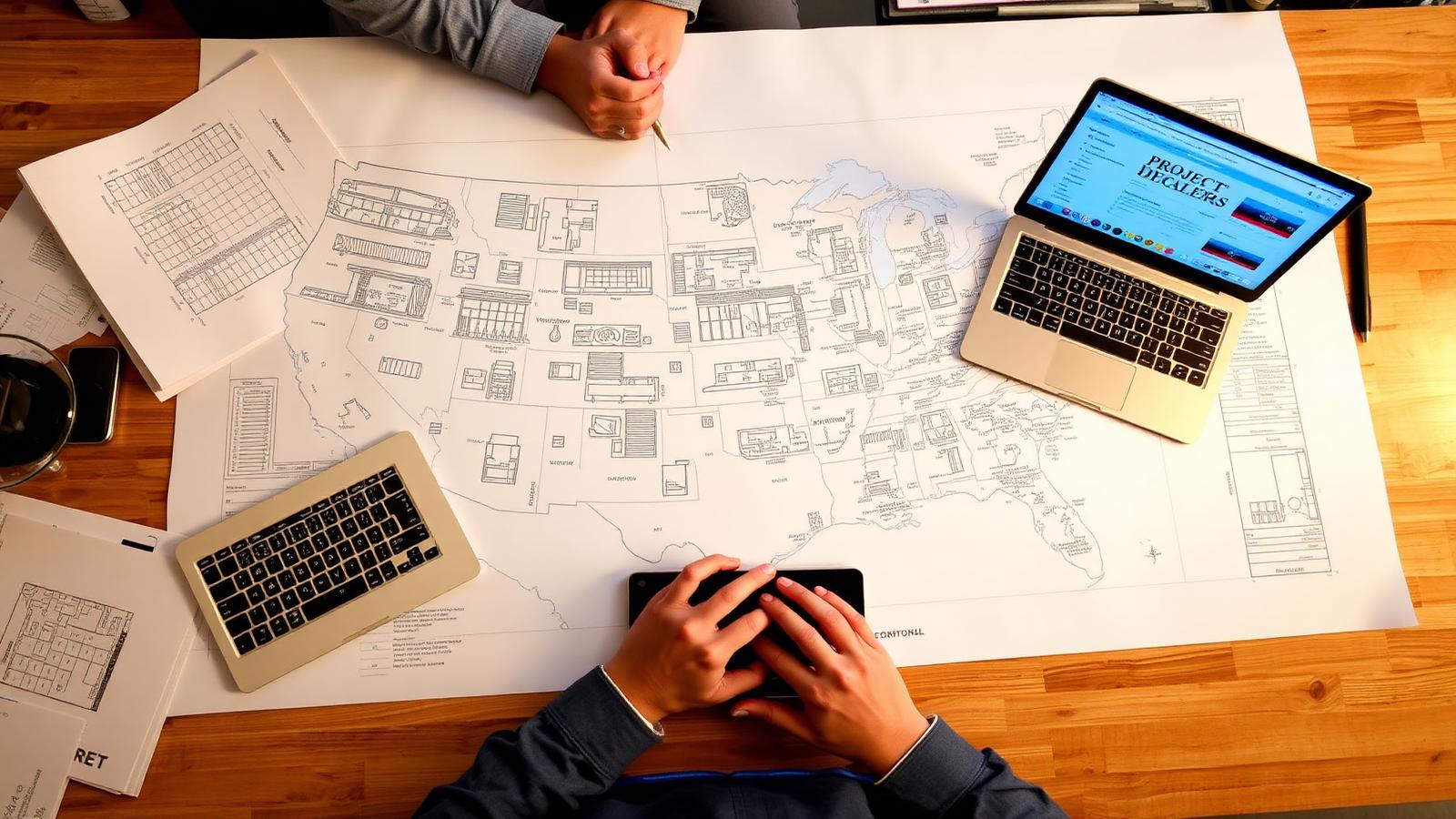
Multi-site retail rollouts are not bigger versions of one project — they are different kinds of work entirely. Opening 12 stores in 18 months requires program-level construction management: standardized prototype delivery, concurrent multi-state execution, centralized reporting, and a GC built for portfolios rather than one-offs. This playbook explains how it actually works.
What "Multi-Site Rollout" Really Means
A rollout is a coordinated program of three or more locations on a committed opening calendar — typically retail, restaurant (QSR, fast-casual), banking, wireless, or franchise operations. The unit of management is the program, not the individual store.
Common shapes:
- Regional expansion — 5–15 stores in adjacent markets over 12 months
- National rollout — 25–100+ stores across multiple regions over 12–36 months
- Franchise rollout — corporate-supported delivery for franchisee operators
- Refresh / remodel programs — 50–500 existing stores reimaged over 12–24 months
Why One-Off GC Selection Fails for Rollouts
If you select a different GC in every market, you pay the learning curve every time:
- Each GC interprets prototype drawings independently → inconsistent execution
- No standardized cost basis → unit pricing varies wildly
- Subcontractor relationships do not transfer → lead times reset
- Owner team manages N independent schedules instead of one program
- Brand-fixture vendors quote N times against N specs
The cost of "lowest local bid" is usually 5–12% in program-level overruns plus calendar slip.
What a Program GC Actually Delivers
Standardized prototype delivery
- Prototype drawings translated to a construction kit-of-parts
- Subcontractor RFP packages standardized across markets
- Value-engineering decisions made once, deployed everywhere
- Brand-fixture coordination centralized
Concurrent multi-state execution
- Field supervision capacity to run 4–8 stores in active construction simultaneously
- Regional superintendents with AHJ fluency in target markets
- Self-perform crews deployed against the critical path
Centralized PM and reporting
- One program PM, one schedule, one budget rollup
- Weekly program report — units in design, permitting, construction, open
- Risk register at program level (long-lead, AHJ trends, market cost shifts)
- Standardized closeout deliverables per location
Procurement leverage
- Long-lead equipment ordered against the program forecast, not per site
- Fixed unit pricing on commodity scope across the rollout
- National vendor agreements with consistent SLAs
The Rollout Workflow
| Phase | Duration | Output |
|---|---|---|
| Program preconstruction | 8–12 weeks | Prototype kit-of-parts, market analysis, program GMP framework |
| Site-specific design adaptation | 3–5 weeks per site | Adapted CDs against AHJ |
| Permitting | 4–12 weeks per site | Issued permits |
| Construction | 10–20 weeks per site | TCO/CO |
| Program closeout | Rolling | Standardized punch and warranty |
Pacing the Calendar
Critical-path sequencing for a rollout:
- Pipeline — sites under LOI / lease negotiation
- Design adaptation — sites entering CDs
- Permitting — sites at AHJ
- Construction in progress
- Opened
Healthy programs maintain enough sites in each bucket to keep the construction queue full without overwhelming permitting or design capacity. The bottleneck moves over the program lifecycle — the program GC's job is to see the bottleneck two phases ahead and reallocate.
What to Require in a Program GC RFP
- Multi-state licensure across your target markets
- Documented concurrent program capacity (3+ active sites)
- A named program PM with comparable rollout experience
- Self-perform capability on critical-path scope
- Standardized weekly reporting format
- Long-lead procurement against your program forecast
- References from comparable rollouts (not single-site projects)
Related Reading
- Retail store buildout cost
- Restaurant construction cost per square foot
- How to choose a commercial general contractor
Bring a Rollout-Capable Partner In Early
Frans Construction delivers retail, restaurant, banking, and franchise programs concurrently across California, Arizona, Nevada, Oregon, Washington, Utah, Colorado, and Idaho. Request a program review — we will respond with a rollout-specific approach within five business days.